Farley Mowat–Ootek
Never Cry WolfFarley Mowat–Ootek is a friendship and research partnership formed at Wolf House Bay, where Ootek’s familiarity with wolves and Mowat’s habits of observation gradually became mutually sustaining. Ootek helped Mowat interpret animal behavior and local knowledge that he could not reach alone; Mowat, in turn, took Ootek’s accounts seriously enough to record and test them. Their relationship changes the terms of the research: the wolves are no longer approached only through a distant telescope, but through a collaboration grounded in listening, translation, and trust.
First Meeting and the Gift of Eggs
Ootek entered Mowat’s life during the final stages of the mouse-eating experiment. Mike returned to his cabin with his young cousin Ootek, and Mowat met them there while collecting supplies. The first encounter was stiff: Mike seemed inclined to ignore Mowat, while Ootek, after being introduced, shifted to the far side of the table. Mike had fried venison from a caribou killed well to the north and offered Mowat a plate, but Mowat declined because he was continuing his dietary experiment. He explained why, and Ootek learned the reason from Mike.
That evening, Ootek waited outside the cabin as Mowat prepared to return to the observation tent. He offered a small deerskin parcel tied with sinew. Inside were five small blue eggs. Mowat ate them as a tiny omelette, reasoning that they were too little to invalidate the experiment, and made a point of showing that he enjoyed them. Ootek’s visible relief suggested that the gift had been intended as a protective gesture. The exchange did not erase the awkwardness of their first meeting, but it gave their acquaintance a practical beginning: Mowat accepted something offered in care, and Ootek saw that his concern had been received rather than dismissed.
A Companion Joins the Research
Mowat later learned that Ootek was a minor shaman in his community. Ootek had apparently inferred from Mike’s stories and Mowat’s unusual routines that Mowat was a shaman too, though of an unfamiliar kind. Mowat presents this explanation cautiously, acknowledging that Ootek may also have hoped to learn from association. Whatever the mixture of curiosity and shared purpose, Ootek made a clear choice: the next day he appeared at the observation tent with his sleeping robe, prepared to stay.
Mowat’s concern that a visitor might disrupt his work quickly gave way to appreciation. Ootek knew a few English words taught by Mike, and his perceptiveness helped the two men establish rudimentary communication. He understood that Mowat was studying wolves and conveyed that he was interested in them as well. His personal totem was Amarok, the Wolf Being, a connection that helps explain why he regarded wolves not as distant objects of study but as actual relations.
Ootek’s knowledge was also rooted in experience. He told Mowat that, when he was about five, his father, a respected shaman, had taken him to a wolf den and left him there for twenty-four hours. Ootek recalled playing with the pups on equal terms; adult wolves sniffed him but did not harm him. Mowat did not accept every account without corroboration. He states that whenever supporting evidence could be obtained, Ootek proved right. Their partnership thus rested neither on untested deference nor on the assumption that only formal scientific observation could yield knowledge: Ootek’s testimony prompted questions, and observation supplied checks where it could.
Learning to Listen to Wolves
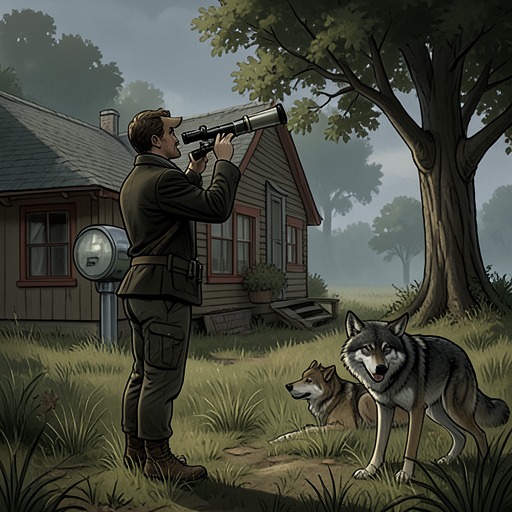
Before Ootek arrived, Mowat had already recorded a wide range of wolf sounds and noticed that individual wolves appeared to respond intelligently to one another. He could not establish whether those sounds were more than simple signals. His own fieldwork also exposed the limits of looking alone. At one point he concealed himself behind a rocky knoll about four hundred yards from the den and searched the surrounding esker through a powerful telescope, but saw no wolves. In the immense open country, a close view seemed unlikely without extraordinary luck.
Ootek altered that situation by attending to what Mowat could not hear. A few days after his arrival, while the men watched a quiet den site, Ootek cupped his hands to his ears and pointed toward hills about five miles away. Mowat heard only the mosquitoes, but George rose, turned north, and howled. Ootek understood the distant sound as news that caribou were moving south. Through Mike, who interpreted their conversation, Mowat learned Ootek’s fuller account: a wolf in the neighboring territory had relayed the caribou’s movement and location, passing on information received from a still more distant wolf. George, having heard the report, was passing it along in turn.
Mowat initially found the account improbable. Mike did not: he packed for a hunting trip, despite the prospect of a two- or three-day walk across the tundra. The contrast made the exchange a turning point. Mowat remained skeptical, but the possibility that Ootek had heard something meaningful stayed with him. He asked Mike to have Ootek keep track of what the wolves said and report it. On a later morning, Angeline repeatedly went to the ridge while George and Uncle Albert were overdue; Ootek again listened and tried to explain what he heard, though Mowat could not yet understand him. The episode did not instantly settle the question of wolf communication. Instead, it established a shared method: Ootek would attend and interpret, while Mowat would keep a record and compare what he learned with observable events.
Knowledge Tested in the Field
The partnership extended beyond vocal communication. Ootek added to Mowat’s understanding of wolf diets, confirming the importance of mice and describing wolves’ use of ground squirrels, which might be preferred to caribou at times. Mowat later watched Uncle Albert fishing for sculpins and tried for pike himself by imitating the method Ootek had described, using a short spear rather than his teeth. These episodes show how Ootek’s accounts could lead to direct observation or a practical test, rather than remaining detached pieces of folklore.
Ootek also changed Mowat’s understanding of the bond between wolves and caribou. He described the two as so closely linked that they were almost one entity, and explained the idea through a traditional story about the creation of animals and the caribou’s place as sustenance. Mowat received the story through Mike’s interpretive help and presented it as part of inland people’s religious folklore. For the research partnership, the story conveyed a relationship between species that could not be reduced to a tally of kills: caribou were central to both human and wolf life, and the animals’ fates were understood together.
The men’s communication also depended on Mike. Ootek’s acceptance of Mowat softened Mike’s attitude. Mike continued to suspect that Mowat was not quite right in the head and might be dangerous, but became more cooperative and served as interpreter. Mowat could later learn some of Ootek’s language, while Ootek improved his English; until then, Mike helped bridge the gap. This three-person arrangement made the research possible while underscoring that Mowat’s access to Ootek’s knowledge was mediated, gradual, and incomplete.
Friendship Beyond the Observation Tent
Their association also extended into shared travel and social life. On a river journey, Ootek recognized a family’s skin tent and introduced Mowat to his people. They spent the afternoon drinking tea, talking, laughing, singing, and eating boiled caribou. The family had camped there to intercept caribou at a downstream river narrows, hoping to secure enough meat for the winter. Ootek wanted to help with the hunt and asked whether Mowat would mind staying behind for a few days. Mowat agreed, allowing his companion to attend to his friends rather than treating the research schedule as the only claim on his time.
That willingness complements the earlier gift of eggs and Ootek’s decision to bring his sleeping robe to the tent: the relationship is built through ordinary acts of consideration as well as shared inquiry. Ootek was not simply a source of information recruited for Mowat’s project. His own attachments—to wolves, to his community, and to the practical demands of hunting—remained visible within their collaboration. Mowat’s accounts of learning from him are strongest when they preserve that distinction: friendship opened a path to knowledge, but it did not make the two men’s experiences or ways of understanding interchangeable.
Significance of the Partnership
Ootek’s role was decisive because he enlarged the range of what Mowat could notice. Mowat could record a wolf’s posture, a howl, or the time at which an animal returned, but he lacked Ootek’s ability to hear meaning in distant sounds and his inherited familiarity with wolves as neighbors and relations. Conversely, Mowat’s insistence on keeping records and seeking confirmation gave Ootek’s accounts a place within an inquiry that tested claims against events where possible. Neither approach simply replaced the other.
The friendship therefore changes the book’s account of field research from solitary watching into a negotiated practice. Mowat’s early difficulty seeing wolves makes the telescope an emblem of both scientific effort and its limits; Ootek’s listening supplies another route into the same world. Their cooperation does not remove uncertainty—Mowat sometimes cannot understand Ootek, and he remains cautious about claims he cannot verify—but it gives uncertainty a productive form. The resulting knowledge depends on sustained attention, translation, and the trust that allows one observer to learn from another.